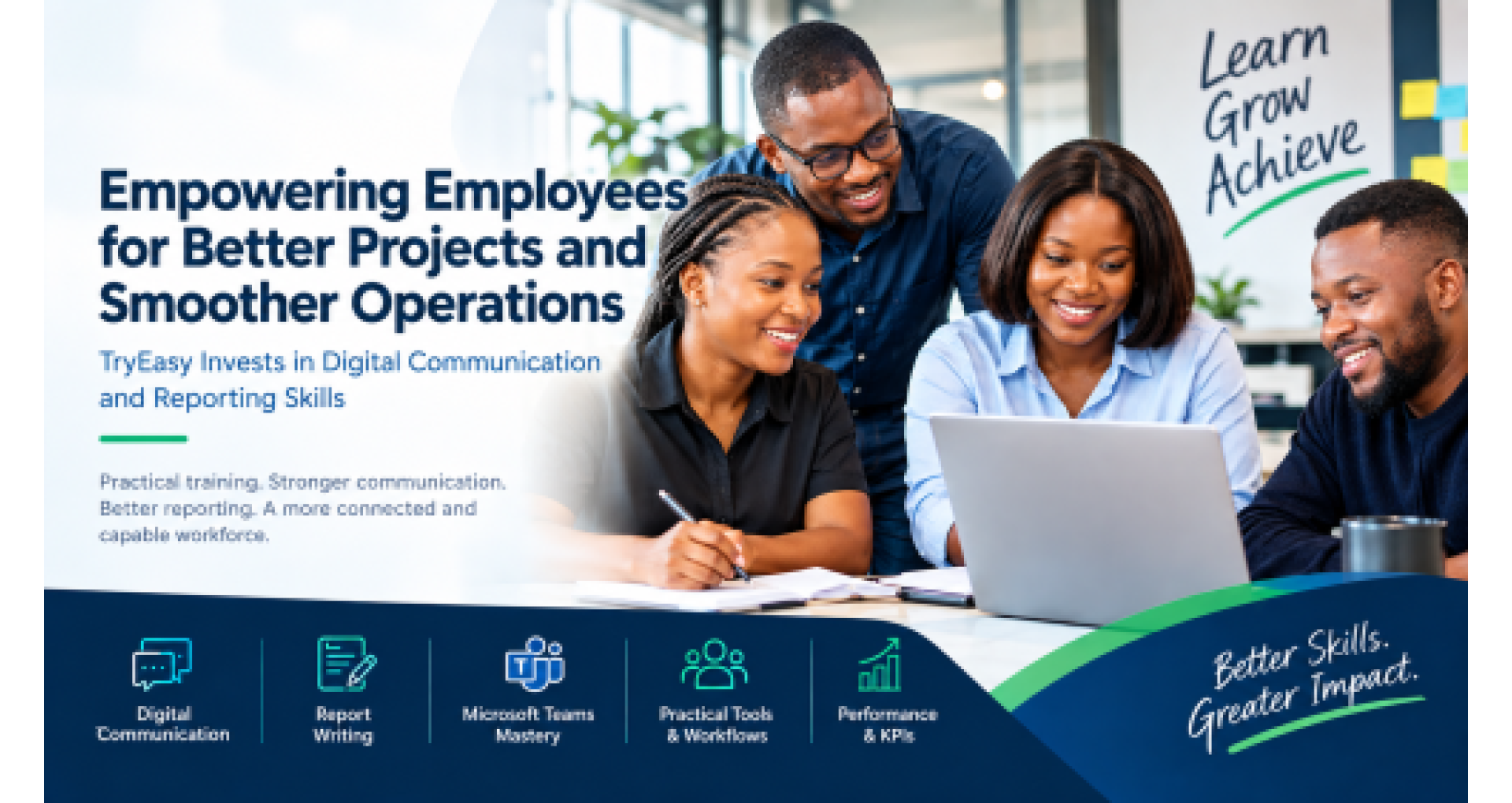
Empowering Employees for Better Projects and Smoother Operations: TryEasy Invests in Digital Communication and Reporting Skills
Building a More Connected, Efficient and Capable Workforce
At TryEasy, we recognise that successful project delivery and smooth day-to-day operations depend on more than technical expertise. Effective communication, accurate reporting, digital capability, collaboration and accountability all play an important role in ensuring that teams work efficiently and projects are delivered to a high standard.
To strengthen these capabilities, TryEasy invested in a structured Digital Communication and Reporting Skills Training Programme, equipping employees with practical tools and knowledge that can be applied directly in their roles.
The programme was designed to strengthen workplace communication, improve reporting capabilities, enhance digital collaboration and encourage greater consistency in the way employees share, manage and document information.
Building Stronger Digital Communication Skills
The training programme introduced employees to the foundations of effective digital communication, focusing on what, why and when digital communication should be applied.
Employees explored the difference between communication and digitisation and were encouraged to consider how digital platforms can improve the way teams collaborate and exchange information.
The programme also covered Microsoft Teams Mastery, helping employees strengthen their use of digital collaboration tools through:
-
Effective use of Teams channels.
-
Meeting setup, etiquette and governance.
-
Digital hygiene and platform best practices.
-
Practical activities to reinforce learning.
These skills can support stronger collaboration between employees, improve information flow and help teams remain connected while working on different projects and responsibilities.
Creating a More Structured Approach to Communication
Another key component of the training was the Communication Toolkit, which equipped employees with practical tools for more structured workplace communication.
Employees were introduced to:
-
Subject tagging conventions.
-
File naming standards.
-
Communication tool selection.
-
Structured communication practices.
-
Practical activities to apply the toolkit.
Having consistent communication practices can make it easier for employees to find information, share documents, follow up on tasks and maintain organised project records.
For TryEasy, this contributes towards creating more streamlined workflows and reducing unnecessary communication gaps.
Strengthening Report Writing and Reporting Capabilities
A particularly valuable aspect of the programme was the focus on report writing and reporting practices.
Reports are an important part of project management and organisational operations. They provide a record of activities, communicate progress, highlight findings and support informed decision-making.
Employees were introduced to reporting structures, closeout reports, progressive reporting methodologies and examples of effective report entries. The training also reinforced the importance of approaching report writing with planning and preparation before beginning the actual writing process.
Learning from the Employees
For TryEasy, the success of employee development is not only measured by the completion of training, but also by how employees understand and apply what they have learned.
Sharon Mabilo highlighted the importance of purpose and clarity when preparing reports:
“A good report is more than just documenting information; it is about communicating clearly, objectively and with purpose.”
Sharon also identified planning and preparation as important foundations of effective report writing. The training reinforced for her the importance of structuring information logically, supporting findings with evidence and ensuring that reports are easy for the reader to understand.
She further noted that being concise while providing sufficient detail can make reports more meaningful and actionable.
“Going forward, I will pay closer attention to the accuracy, clarity and professionalism of my reports.”
For Sharon, the training provided practical skills that she can apply to her day-to-day responsibilities while improving the quality of the reports she produces.
Turning Reporting Knowledge into Practical Skills
Siviwe Mphuthing also highlighted the value of understanding different types of business reports and the appropriate structure and writing style for each.
The training provided insight into informational, informal, periodic and formal reports, as well as the importance of structuring reports according to their purpose and audience.
Siviwe also learned the importance of maintaining an objective and professional writing style, using active voice, avoiding unnecessary jargon or personal information, and paying close attention to grammar and sentence construction.
According to Siviwe, the training reinforced five fundamental principles for effective report writing:
“Write clearly, keep it concise, use active voice, double-check your grammar, and maintain a professional tone.”
These principles are particularly important in a professional environment where reports may be used to communicate project progress, document activities, present findings and support management decisions.
Making Reporting More Meaningful
The training also emphasised that effective reporting is not simply about producing a document. A well-written report should communicate information in a way that allows the reader to understand the situation, identify key findings and take appropriate action.
Employees were therefore encouraged to focus on:
Planning → Structuring → Evidence → Clarity → Review → Action
This approach can help improve the consistency and usefulness of reports across different projects and functions.
Introducing Digital Communication KPIs
The programme further introduced employees to Digital Communication Key Performance Indicators (KPIs) and the importance of measuring communication-related activities.
Employees explored the five layers of digital communication, role-based measurement, ownership and accountability across functions, as well as KPI-focused activities.
This provides employees with a clearer understanding of how their communication practices and responsibilities contribute to broader organisational objectives.
Bringing the Learning Together
The final stage of the programme focused on integration and practical application.
Through role-specific scenarios, an end-to-end communication walkthrough and completion activities, employees had an opportunity to bring together the knowledge gained throughout the different modules.
This practical approach encouraged employees to consider how the training could be applied to their actual responsibilities rather than remaining purely theoretical.
Whether preparing a project report, communicating with colleagues, managing information on Microsoft Teams or documenting project activities, employees can apply the principles learned to improve the way they work.
Creating a More Capable Workforce
TryEasy's investment in employee training reflects the organisation's commitment to continuous learning, professional development and operational excellence.
By strengthening digital communication and reporting capabilities, TryEasy is equipping employees with practical skills that can contribute to:
-
Better project documentation.
-
Clearer internal communication.
-
Improved collaboration.
-
More accurate reporting.
-
Stronger accountability.
-
Better information management.
-
More efficient project coordination.
-
Smoother day-to-day operations.
The training also reinforces an important principle: when employees are equipped with the right tools and knowledge, they are better positioned to contribute to successful projects and organisational growth.
Looking Ahead
As TryEasy continues to deliver projects and support its stakeholders, having employees who can communicate clearly, collaborate effectively and produce accurate, professional reports remains essential.
The insights shared by Sharon Mabilo and Siviwe Mphuthing demonstrate that the value of training extends beyond the classroom. Employees are gaining practical knowledge that can be incorporated into their everyday responsibilities and used to improve the quality of their work.
Through continued investment in employee development, TryEasy is building a workforce that is more digitally capable, better equipped to communicate and prepared to deliver projects with greater structure and efficiency.
Empowering People. Strengthening Skills. Delivering Better Projects.
TryEasy's commitment to employee development is helping transform knowledge into practical workplace capability — creating stronger teams and supporting smoother operations.