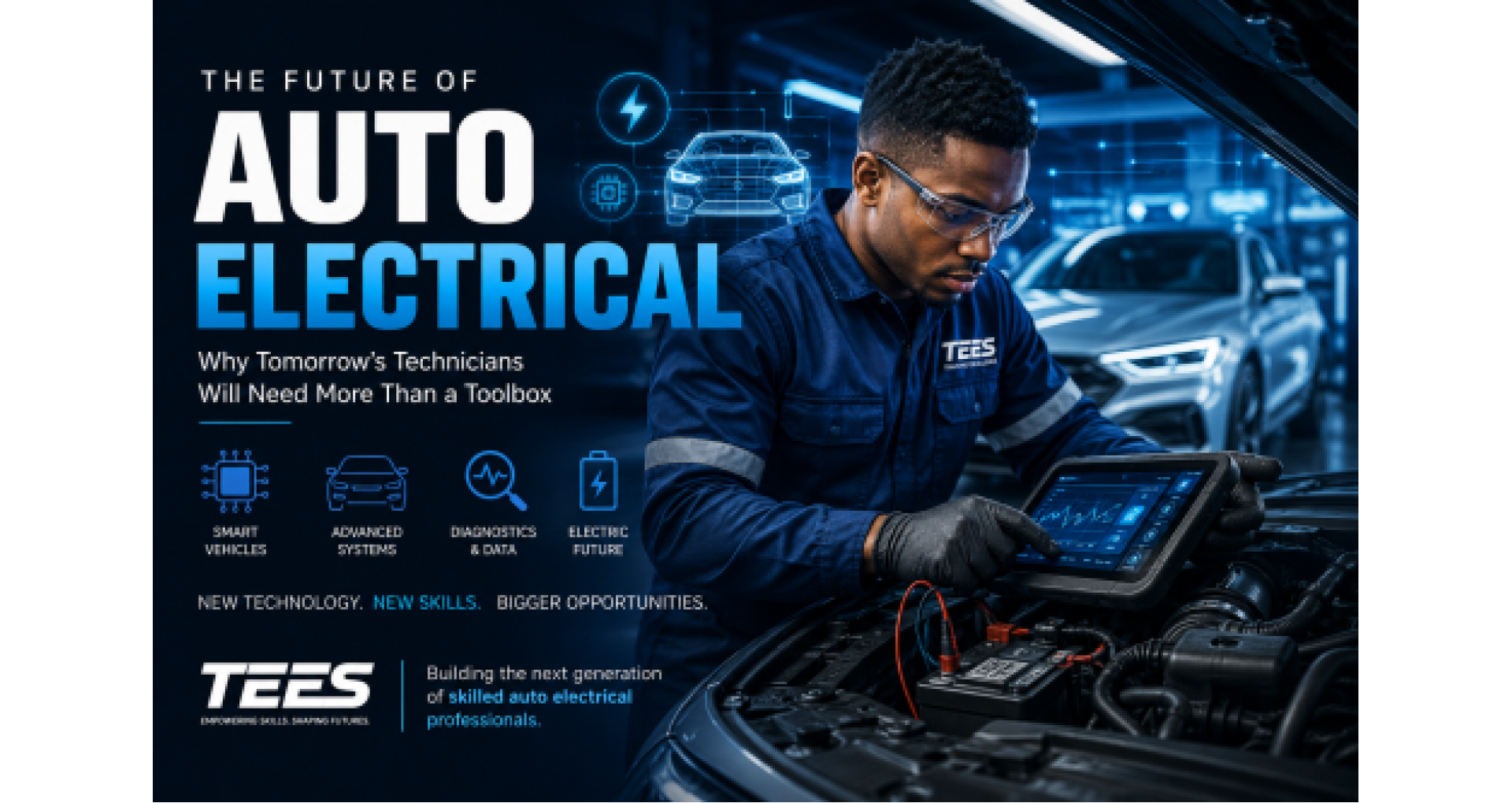
The Future of Auto Electrical: Why Tomorrow’s Technicians Will Need More Than a Toolbox
The Vehicle of the Future Is Already Here
For decades, vehicle repairs were largely mechanical. If a vehicle had a problem, the cause could often be traced to a worn component, a faulty bearing, or a damaged mechanical system.
Today, that reality is changing rapidly. Modern vehicles are becoming increasingly intelligent. From advanced driver assistance systems and electronic fuel management to smart sensors and onboard diagnostics, today's vehicles rely heavily on technology to operate efficiently. In fact, many of the faults technicians encounter today are no longer purely mechanical they are electrical, electronic, or software-related. This shift is transforming the automotive industry and creating new opportunities for those willing to adapt. The future of auto electrical is not simply about fixing wires. It is about understanding how technology, electronics, and diagnostics work together to keep modern vehicles moving.
The Rise of the "Computer on Wheels"
A modern vehicle contains dozens of electronic control units (ECUs), kilometres of wiring, sensors, modules, and communication networks.
Every system communicates.
The engine communicates with the transmission.
The transmission communicates with safety systems.
Safety systems communicate with dashboard displays.
Even something as simple as a window switch can be connected to a larger electronic network.
In many modern vehicles, a warning light on the dashboard is often not the problem itself it is merely a symptom of a deeper issue hidden within the vehicle's electrical architecture.
This means that tomorrow's auto electricians must become skilled investigators.
Success in the industry will increasingly depend on the ability to diagnose, analyse, and interpret information rather than simply replace parts.
The End of Guesswork
One of the biggest changes taking place within the automotive industry is the move away from trial-and-error repairs. Years ago, technicians often relied heavily on experience and intuition. Today, data is becoming just as important as experience. Modern diagnostic tools provide technicians with live information about vehicle systems, sensor readings, voltage levels, fault codes, and communication failures.
The technician of the future must know how to:
-
Interpret diagnostic data
-
Analyse system behaviour
-
Read electrical schematics
-
Understand vehicle communication networks
-
Identify root causes efficiently
In many workshops, the most valuable technician is no longer the one who works the fastest. It is the one who can identify the correct fault the first time.
Electric Vehicles Are Changing the Rules
Electric vehicles (EVs) are often discussed as the future of transport, but they represent something much bigger.
They are changing the skills required within the automotive sector.
Unlike conventional vehicles, EVs rely heavily on:
-
High-voltage electrical systems
-
Battery management systems
-
Electronic control modules
-
Regenerative braking technology
-
Advanced software integration
For technicians, this means continuous learning is no longer optional.
As electric mobility grows across the world and gradually expands within South Africa, the demand for specialised electrical knowledge will continue to increase. Those who invest in learning today will be better positioned for the opportunities of tomorrow.
Cybersecurity and Vehicle Technology
A topic that is rarely discussed in automotive training is cybersecurity. Many modern vehicles are now connected to mobile applications, cloud services, GPS systems, and wireless communication networks.
As connectivity increases, so does the importance of protecting vehicle systems.
Future auto electrical professionals may find themselves working with technologies that combine electrical systems, software, and network security. This creates entirely new career paths that did not exist a decade ago. The automotive technician of the future may need to understand both voltage and data.
Why Human Skills Will Still Matter
Despite all the technological advancements, one thing remains constant: people.
Customers still need technicians who can communicate clearly, explain technical issues, and provide professional service. As technology becomes more complex, the ability to translate technical information into understandable language becomes increasingly valuable.
The most successful technicians will combine:
✔ Technical expertise
✔ Diagnostic ability
✔ Problem-solving skills
✔ Professional communication
✔ Continuous learning
Technology may evolve, but trust remains essential.
Preparing for the Future Starts Today. The automotive industry is entering one of the most exciting periods in its history. Vehicles are becoming smarter, systems are becoming more advanced, and the demand for specialised skills is growing. For aspiring auto electricians, this presents an incredible opportunity.
The future belongs to individuals who are willing to learn, adapt, and stay ahead of industry change.
At TEES, we recognise that technical training must evolve alongside industry requirements. That is why practical experience, diagnostic capability, workplace readiness, and continuous skills development remain at the centre of what we do.
Because the auto electrician of tomorrow will not simply repair vehicles.
They will understand technology, solve complex problems, and help drive the future of mobility.
Final Thought
The next generation of automotive professionals will need more than spanners and screwdrivers. They will need critical thinking, diagnostic expertise, technological awareness, and a commitment to lifelong learning.
The future of auto electrical has already arrived.
The question is: are we ready for it?